
By Madeline Bonner, Monuments Toolkit
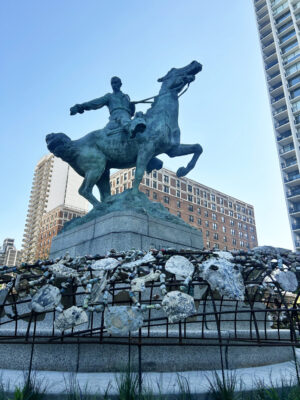
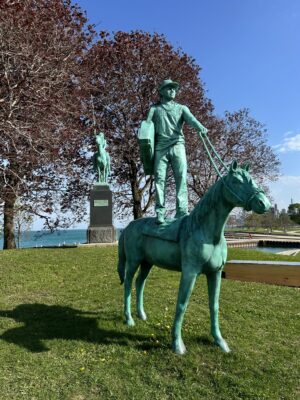
Chicago’s lakefront and green spaces were buzzing with activity during a weekend visit to one of my favorite urban landscapes. The first few sunny and relatively warm spring days always pull Chicagoans out of the house in impressive numbers. I returned to two spaces I’d passed by and lingered in numerous times while living in Chicago: the intersection of Belmont and N. Lake Shore Drive and Diversey Harbor. Each spot was bustling in a different way. Diversey Harbor was filled with people sitting to view the city skyline and walking, running, or biking the Lakefront Trail. The intersection of Belmont and N. Lake Shore Drive was jam-packed with cars and buses trying to pass through the awkward intersection. In each of these places stand controversial monuments and their recently added site-responsive installations. The Chicago Monument Response Project initiative is an outcome of the work of the Chicago Monuments Project (CMP).
The Chicago Monuments Project
Since 2020, Chicago has been leading the way in creating initiatives with the goal of understanding and addressing controversial monuments in the city’s public space. The Chicago Monuments Project was launched in 2020 as a collaboration between the city’s Department of Cultural Affairs and Special Events (DCASE), Chicago Public Schools, and the Chicago Park District. The Project’s advisory committee brought experts and leaders together from different spaces to ask: “Who is missing from our public memory? How can we tell a fuller, more truthful story?”
The Chicago Monument Project’s work and 2022 report serve as a model for civic leaders seeking to implement an audit of their monument landscape. The document outlines the Project’s guiding principles, methodology, and recommendations alongside essays by experts. Of over 500 sculptures, plaques, and artworks in Chicago, 41 were identified as in need of further discussion. These include sculptures of Christopher Columbus, Benjamin Franklin, Abraham Lincoln, and William McKinley as well as monuments related to the Fort Dearborn Massacre, “pioneers,” and “discoverers,” among others.
The reasons these works were chosen for further public discussion include “Promoting narratives of white supremacy,” “Presenting inaccurate and/or demeaning characterizations of American Indians,” “Memorializing individuals with connections to racist acts, slavery and genocide,” “Presenting selective, oversimplified, one- sided views of history; Not sufficiently including other stories, including those of women, people of color, and themes of labor, migration and community building,” and “Creating tension between people who see value in these artworks and those who do not” (CMP Report, p.12).
The CMP made treatment recommendations for each of the 41 identified monuments that included revise or add narrative, modify, take down, re-site, and replace (CMP Report, p.40). The 2022 report suggested “take down” treatment for the General Philip Henry Sheridan Monument and “review or add narrative” treatment for A Signal of Peace.
The General Philip Henry Sheridan Monument (1923) was identified as a controversial work due to Sheridan’s use of his “scorched-earth” tactics against the Indigenous American tribes of the Great Plains. Sheridan led the Army’s Military Division of the Missouri in a violent and aggressive campaign against the Cheyenne, Kiowa, Sioux, and Comanche Tribes of the plains regions. In the years following 1869, the Military Division aimed to destroy the Tribes’ lifeways, food stores, villages, and the buffalo population on which they depended. In addition, the CMP identified the fact that the sculpture had been vandalized multiple times and the “source of adverse public reaction” as a reason for its closer review. Chicago’s Sheridan monument was created by Gutzon Borglum, the same person who carved the face of Robert E. Lee at Stone Mountain and worked on Mount Rushmore.
The A Signal of Peace (1890) sculpture was reviewed as a controversial work due to its stereotypical portrayal of a non-specific Indigenous American person. To read more about the historic and contemporary implications of monuments depicting Indigenous Americans that were created by non-Natives, see “Monuments, Memorials & the Power of ‘Memory’” by John N. Low (CMP Report, p. 15). The creator of A Signal of Peace, Cyrus Edwin Dallin, also sculpted Appeal to the Great Spirit.
Ultimately, both monuments were chosen for artistic intervention through the Chicago Monument Response Project.
From Discussion to Action
The responses to CMP’s call “Reimagining Monuments: Request for Ideas” made clear the collective interest in engaging with Chicago’s existing public art through different methods of intervention. Artistic interventions can provide missing context to a monument’s historical narrative, lead the viewer to reconsider the subject, and/or prompt dialogue between viewers. Two site-responsive installations, We Still Here and TIERRA NUESTRA, provide examples of the power of artistic interventions.
The Chicago Monument Response Project Initiative chose artists Sonja Henderson, Sadie Woods, and Hector Gonzalez to create site-responsive installations through a formal Request For Proposals (RFP) process led by the Chicago Parks District. Following years-long creation processes, the two temporary public art installations opened to the public on April 8, 2026.
The Chicago Monument Response Project follows the Monuments Toolkit’s framework of co-location: “the act of adding additional monuments to temper the meaning and significance of the original monument.”
We Still Here
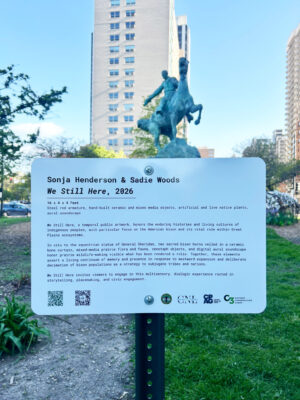
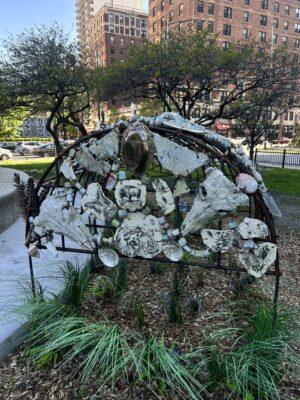
We Still Here by artists Sonja Henderson and Sadie Woods is located within a triangle of space between the streets of Belmont and N. Lake Shore Drive. It was created in response to the General Philip Henry Sheridan Monument. The signage provides a description of the installation and its intention:
Steel rod armature, hand-built ceramic and mixed media objects, artificial and live native plants, aural soundscape. We Still Here, a temporal public artwork, honors the enduring histories and living cultures of Indigenous peoples, with particular focus on the American bison and its vital role within Great Plains ecosystems. In situ to the equestrian statue of General Sheridan, two sacred bison horns veiled in ceramic bone curtain, mixed-media prairie flora and fauna, cenotaph objects, and digital aural soundscape honor prairie wildlife – making visible what has been rendered a relic. Together, these elements assert a living continuum of memory and presence in response to westward expansion and deliberate decimation of bison populations as a strategy to subjugate tribes and nations. We Still Here invites viewers to engage in this multisensory, dialogic experience rooted in storytelling, placemaking, and civic engagement.
TIERRA NUESTRA
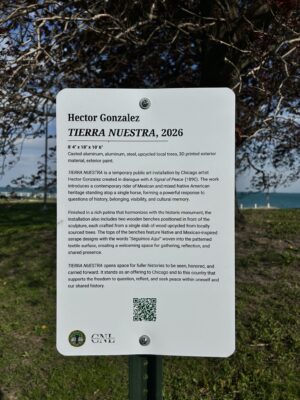
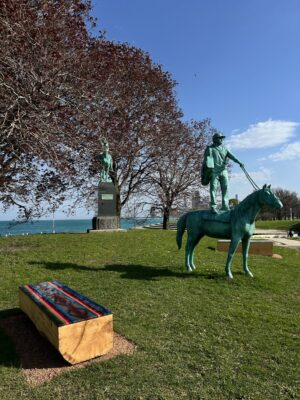
TIERRA NUESTRA by artist Hector Gonzalez stands next to the Lakefront Trail at Diversey Harbor. It draws attention as it stands out from the deep blue background of Lake Michigan. The artwork was created in response to A Signal of Peace. The signage reads:
Casted aluminum, aluminum, steel, upcycled local trees, 3D printed exterior material, exterior paint. TIERRA NUESTRA is a temporary public art installation by Chicago artist Hector Gonzalez created in dialogue with A Signal of Peace (1890). The work introduces a contemporary rider of Mexican and mixed Native American heritage standing atop a single horse, forming a powerful response to questions of history, belonging, visibility, and cultural memory. Finished in a rich patina that harmonizes with the historic monument, the installation also includes two wooden benches positioned in front of the sculpture, each crafted from a single slab of wood upcycled from locally sourced trees. The tops of the benches feature Native and Mexican-inspired serape designs with the words “Seguimos Aqui” woven into the patterned textile surface, creating a welcoming space for gathering, reflection, and shared presence. TIERRA NUESTRA opens space for fuller histories to be seen, honored, and carried forward. It stands as an offering to Chicago and to this country that supports the freedom to question, reflect, and seek peace within oneself and our shared history.
Artist Intervention Initiatives Outside of Chicago
Unofficial artistic interventions such as yarn-bombing, graffiti, paint, and cloaking have been relatively common as responses to controversial monuments.
One example of an official artistic intervention project outside of Chicago is the Boston Museum of Fine Art’s (MFA Boston) Huntington Avenue Entrance Commission. The museum launched the commission initiative in 2024 as part of the broader effort to reimagine the museum’s campus. The Huntington Avenue entrance is a prime space for dialogue between artworks as this is where the problematic Appeal to the Great Spirit sculpture continues to stand. Indigenous American artist and curator Alan Michelson was commissioned to create the initiative’s first installation: The Knowledge Keepers.
The Knowledge Keepers includes two sculptures depicting contemporary individuals from local tribes: Aquinnah Wampanoag member Julia Marden and Nipmuc artist Andre StrongBearHeart Gaines Jr. Both stand in “dynamic gestures of public address” atop plinths on either side of the Huntington Avenue entrance doors. Of the works, Michelson stated: “In 2024, I hope my site-specific installation will challenge ingrained stereotypes and racial myths by presenting a story of survivance and agency, not defeat or appeal.” The bronze sculptures with platinum gilt are another example of the power of co-location. The juxtaposition of Michelson’s sculptures of specific contemporary Indigenous knowledge keepers with Cyrus Dallin’s stereotypical and inaccurate depiction of a non-specific Indigenous American person challenges visitors to think critically about the implications of monuments such as Appeal to the Great Spirit and A Signal of Peace.
A Model For Change
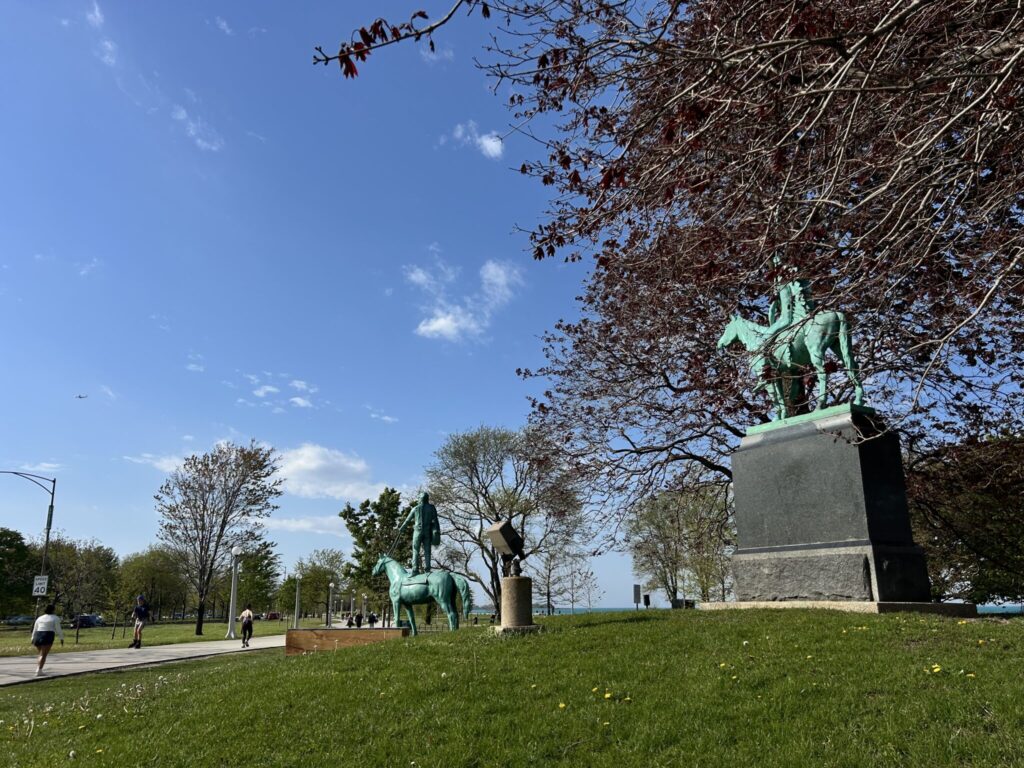
While visiting the sites of We Still Here and TIERRA NUESTRA, I saw a number of people engaging with the installations. Passersby who appeared to be Chicagoans on their regular lakefront walk detoured a few steps off the paved path to read the signage describing TIERRA NUESTRA. Later in the day, someone making their way to the Lake Shore Drive & Belmont stop took a moment to walk around We Still Here while they waited for the next bus.
TIERRA NUESTRA (left) and A Signal of Peace (right). May 3, 2026. Images courtesy of the author.
Both installations will stand for two years. It will be interesting to see what they accomplish in that time period and where Chicago’s monument dialogue will be when they are inevitably removed from the landscape. According to the Chicago Parks District,
Over the two-year exhibition, [We Still Here and TIERRA NUESTRA] will present multiple public programs, performances, and educational events engaging thousands of Chicago residents and visitors. Through partnerships with cultural institutions and community organizations, the installations will expand dialogue around monuments, historical memory, and cultural representation while modeling new approaches to public art in public spaces.
The CMP and its resulting projects are worth following closely. The Monuments Toolkit has investigated numerous different civic responses to controversy within the monument landscape that includes city property. Chicago’s approach is comprehensive, practical, and rooted in community input. Artists such as Sonja Henderson, Sadie Woods, and Hector Gonzalez do the critical work of proposing and creating dialogue responses in the form of public art pieces informed by their expertise and experience. It is exciting to see Chicago’s urban landscape continue to grow and evolve to make space for some of the city’s most important narratives.