

By Noah Price, Monuments Toolkit
Lately, I’ve developed a habit of searching the internet for history that happened “on this day” or #OTD. Earlier this month, on December 9, I discovered that it was the anniversary of a major first for Black Americans. On that day in 1872, P.B.S. Pinchback became the first Black governor of a state, specifically Louisiana.
However, that year and particular elected office immediately stood out to me. Almost instantaneously, I remembered the site of a former monument that I visited in New Orleans a few months ago. The Battle of Liberty Place monument was erected in remembrance of the 1872 gubernatorial election in Louisiana, but it had nothing to do with this major historical first. So today, I’d like to tell you about both Pinchback’s history and the history of this former monument.
P.B.S. Pinchback
After the Civil War ended and the United States ratified the 13th through 15th amendments, states began to elect some of their first Black men into office. P.B.S. Pinchback became a member of the Louisiana State Senate and ultimately rose to the top rank of President Pro Tempore. At the same time, Oscar Dunn, another Black man in Louisiana, joined the gubernatorial ticket with Republican soon-to-be Governor Henry Clay Warmoth and soon became the first Black Lieutenant Governor in the United States.
A trailblazer himself – and a man that some consider to be the first Black governor due to a 36 day stint as acting governor – Dunn unfortunately passed away while in office. Warmoth elevated Pinchback to this role, making him the second Black Lieutenant Governor in the United States.
In 1872, Louisiana held yet another gubernatorial election. Neither the incumbent governor, Warmoth, or Pinchback were part of the race. However, Warmoth intervened in the election results and helped declare John McEnery, a Democrat, the winner of the election. Warmoth was impeached due to accusations that he “stole the election,” forcing P.B.S. Pinchback to take the office of Louisiana governor for the remainder of the term. Although only 35 days, Pinchback signed several bills into law and took the oath of office, making him the first Black governor.
The Battle of Liberty Place
Despite the historic nature of Pinchback’s gubernatorial seat, the intensity of the election did not fade with Warmoth’s impeachment. President Ulysses S. Grant intervened and ultimately instated William Pitt Kellogg, the Republican gubernatorial candidate, to the seat instead of Warmoth’s chosen McEnery as the results most likely favored Kellogg.
This did not put McEnery and the Southern Democrats to rest. Instead, McEnery created a rival administration and labeled Kellogg as a usurper. Many former Confederate soldiers and white supremacists who supported McEnery created the White League and began to stockpile weapons.
On September 14, 1874, the Battle of Liberty Place ultimately began. The conservative Democrats led a riot into the center of the city. President Grant retaliated by sending in the U.S. Army and fighting occurred for 3 days with the White League retaining control during that time. However, they ultimately surrendered and Kellogg retook control of the executive in Louisiana.
Kellogg and Republican control in Louisiana weakened despite their victory and the White League continued to grow. Within years, power shifted back to conservatism in New Orleans and the state and effectively ended reconstruction in Louisiana.
The Monument
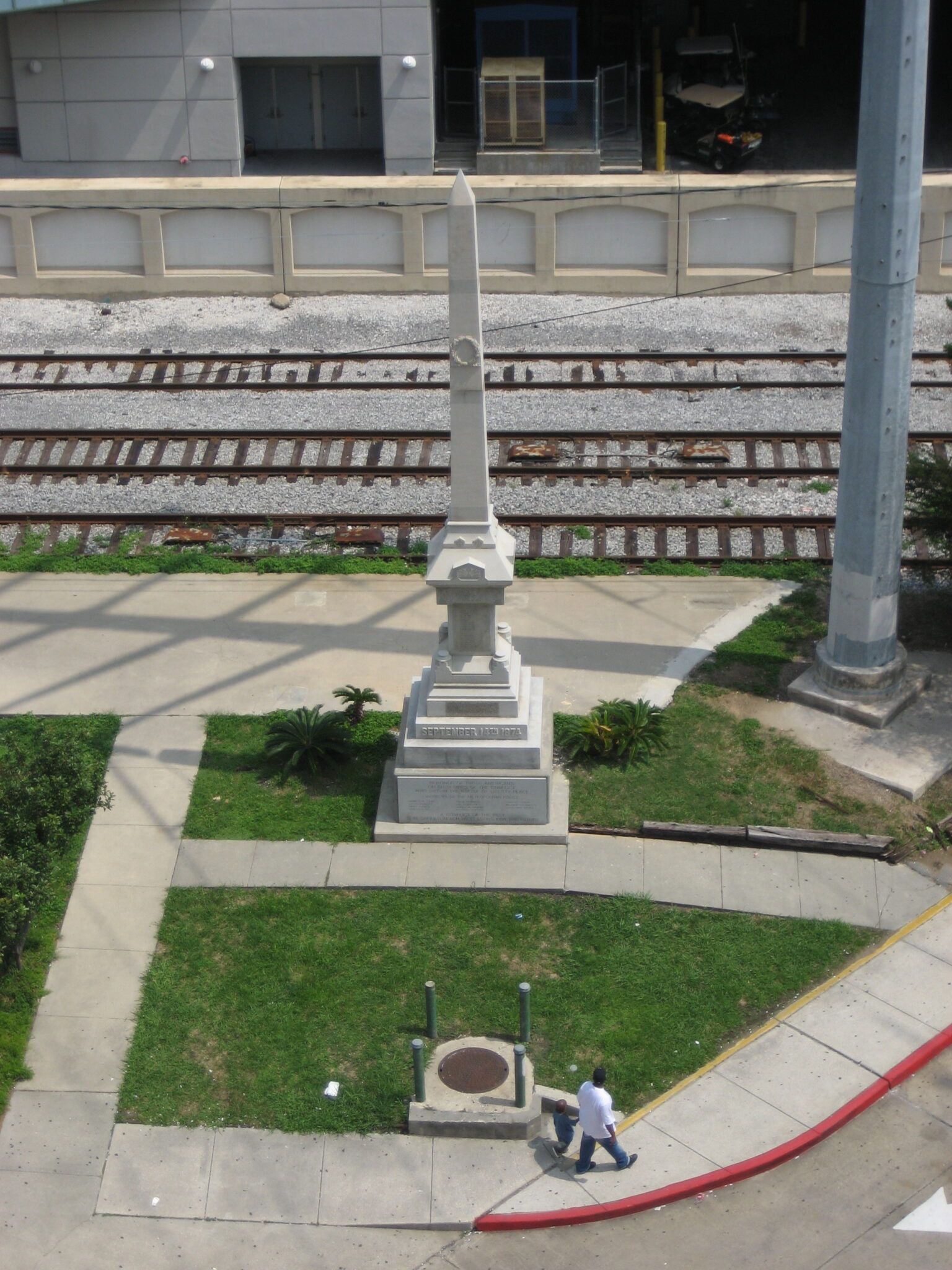
As the White League grew, so did the idea that a monument should rise to remember the event. In 1891, “the city installed the Liberty Monument at the foot of Canal Street to commemorate the White League dead” and it instantaneously became a symbol of white supremacy. Calls to remove the monument echoed just as quickly as the monument rose, but for more than a century, the obelisk remained mostly untouched.
In the latter half of the twentieth century, the monument finally began to undergo a few changes. It moved locations a number of times and there were attempts to reinterpret the monument with plaques that better explained the history, but ultimately, no updated location or new plaque could change that the monument honored white supremacy and a treasonous event. In 2017, it was finally removed.
Last March, I was traveling through New Orleans and visited the site that the monument used to stand. While researching the Battle of Liberty Place and the monument, never once did I stumble upon the concurring history of P.B.S. Pinchback and his role as the first Black governor, despite how intertwined these histories seem.
Today, there are still no major monuments to the country’s first Black governor. In 2020, Louisiana finally created a historical marker in Alexandria. However, this seems rather small compared to the significance of Pinchback in American history. It especially seems small when compared to the monument erected as a result of the contested election of 1872 and the riot that ensued in 1874.
Ultimately, the Battle of Liberty Place monument reflects how monuments often select small pieces of history to memorialize rather than larger historical events. It is a clear choice that a monument stood to memorialize a riot, but one has never stood to memorialize the first Black governor. Perhaps now that the pedestal in which the Battle of Liberty Place monument once stood now only holds a power box, it’s time to consider creating a monument to P.B.S. Pinchback, Oscar Dunn, or any of the other Black trailblazers in the state.