
By Gilbert C. Correa, Monuments Toolkit
Introduction
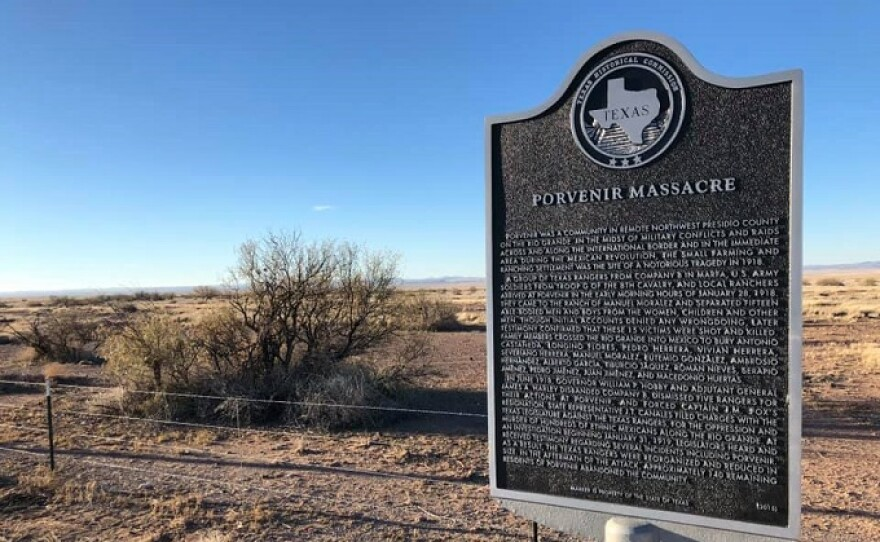
The Porvenir Massacre, which occurred on January 28, 1918, in Presidio County, Texas, represents a critical, albeit historically suppressed, example of state-sanctioned violence against Mexican-descent residents during the Mexican Revolution. Amidst heightened border tensions and anti-Mexican sentiment in the southwestern United States, a posse of Texas Rangers, U.S. Army cavalrymen, and local Anglo ranchers executed 15 unarmed Mexican men and boys. This incident, part of the broader, violent era known as La Matanza (the massacre), highlights the intersection of racism, land grabbing, and law enforcement impunity in early 20th-century Texas.
Contextual Factors and the “Bandit War”
The Mexican Revolution and the 1915 Plan de San Diego, which sought to retake Texas territory, contributed to the significant bloodshed that occurred along the U.S.-Mexico border between 1910 and 1920. Local fears and demands for retribution against Mexican settlements grew after a raid on the Brite Ranch in December 1917, where suspected rebels massacred citizens. Texas Rangers from Company B, joined with ranchers and federal soldiers, targeted the village for retaliation even though there was no hard proof linking the farming settlement of Porvenir to this raid.
The Event: January 28, 1918
On the morning of January 28, 1918, Texas Rangers and their accomplices entered Porvenir, separated 15 men and boys—ranging from 16 to 72 years old—from their families, and marched them to a nearby bluff. These individuals were systematically shot and killed. The survivors, primarily women and children, fled across the border to Mexico, and in the aftermath, the U.S. Army burned the remaining homes, effectively erasing the settlement.
Accountability and Historical Significance
In the immediate aftermath, no criminal charges were filed against the perpetrators. However, the brutality of the incident helped spark a 1919 Texas legislative investigation led by9 Representative J.T. Canales, which documented extensive Ranger misconduct and resulted in the reorganization of the force. The Porvenir massacre was largely forgotten by mainstream history for a century, obscured by a “code of silence” and local narratives that failed to account for the actions of state agents.
Recent scholarly and archaeological efforts, including a 2015 study, have reaffirmed the location of the massacre and confirmed that both civilian and military weapons were utilized (John MacCormack 2016). The Porvenir Massacre serves as a pivotal case study for understanding the role of state law enforcement in enforcing racial hierarchies and the enduring trauma of borderland violence.
Work Cited
John MacCormack (2016). “Did U.S. Cavalry massacre civilians on the border?” Accessed Thursday 26 February 2026. https://cbbs.sulross.edu/keller-porvenir-massacre/#:~:text=Recent%20archaeological%20work%2C%20including%20analysis,Doubt%20is%20cast