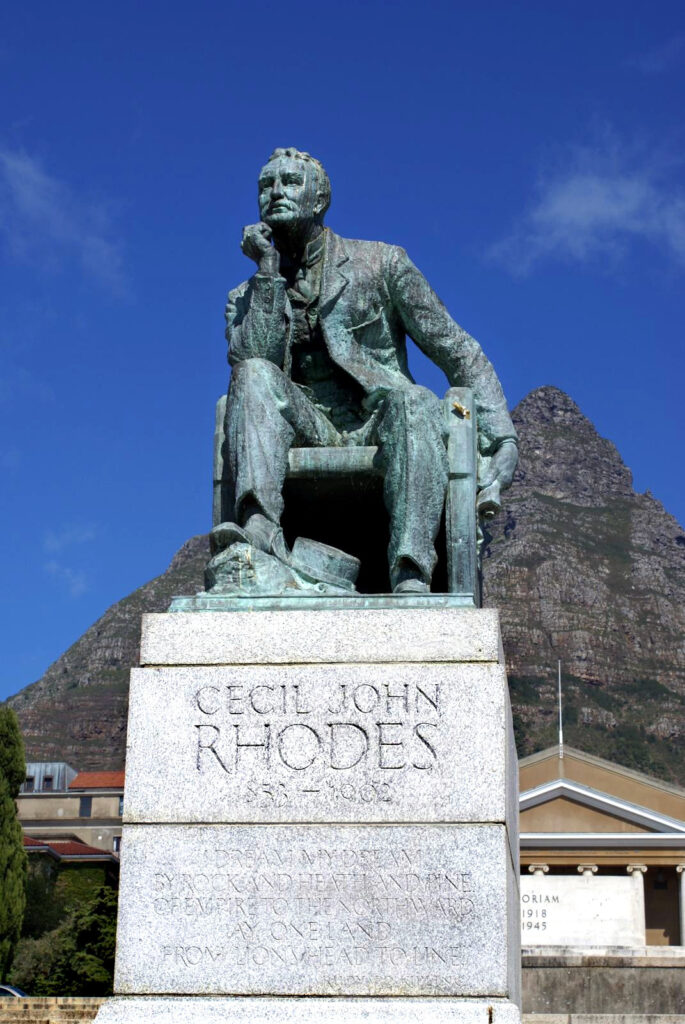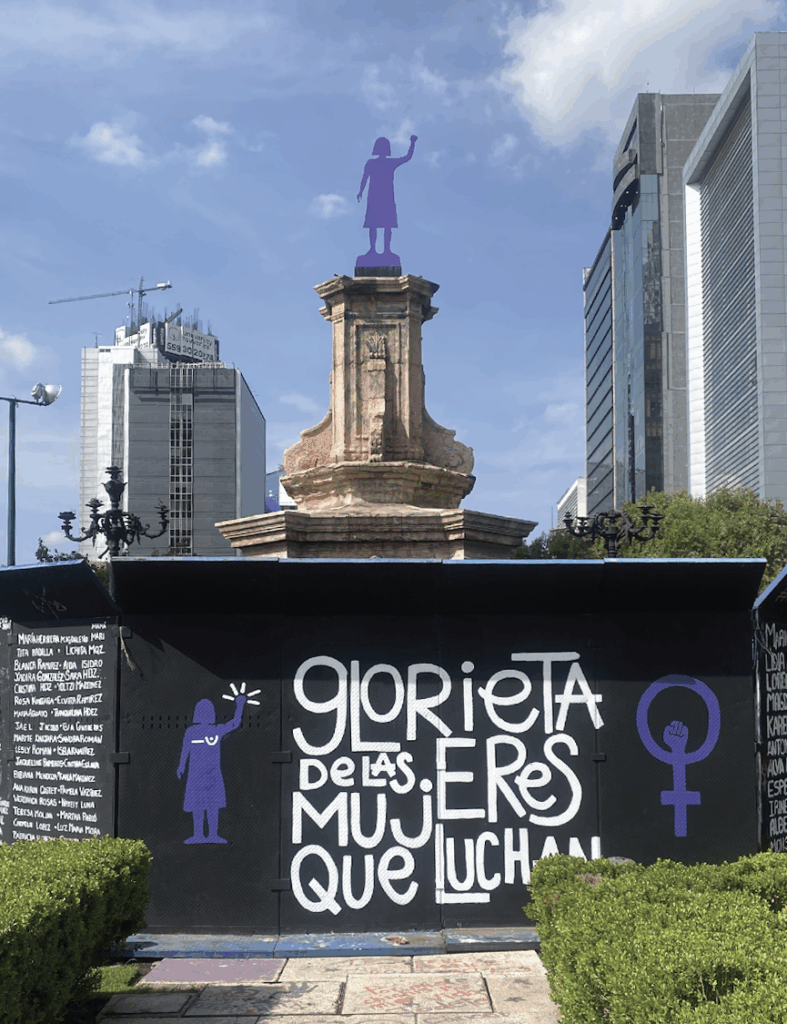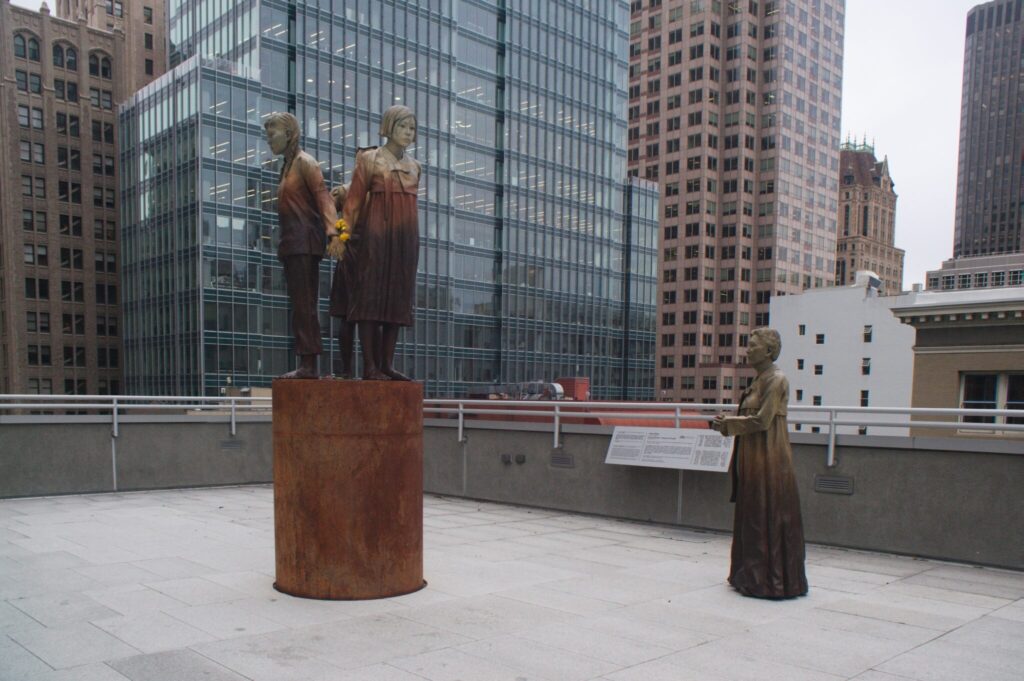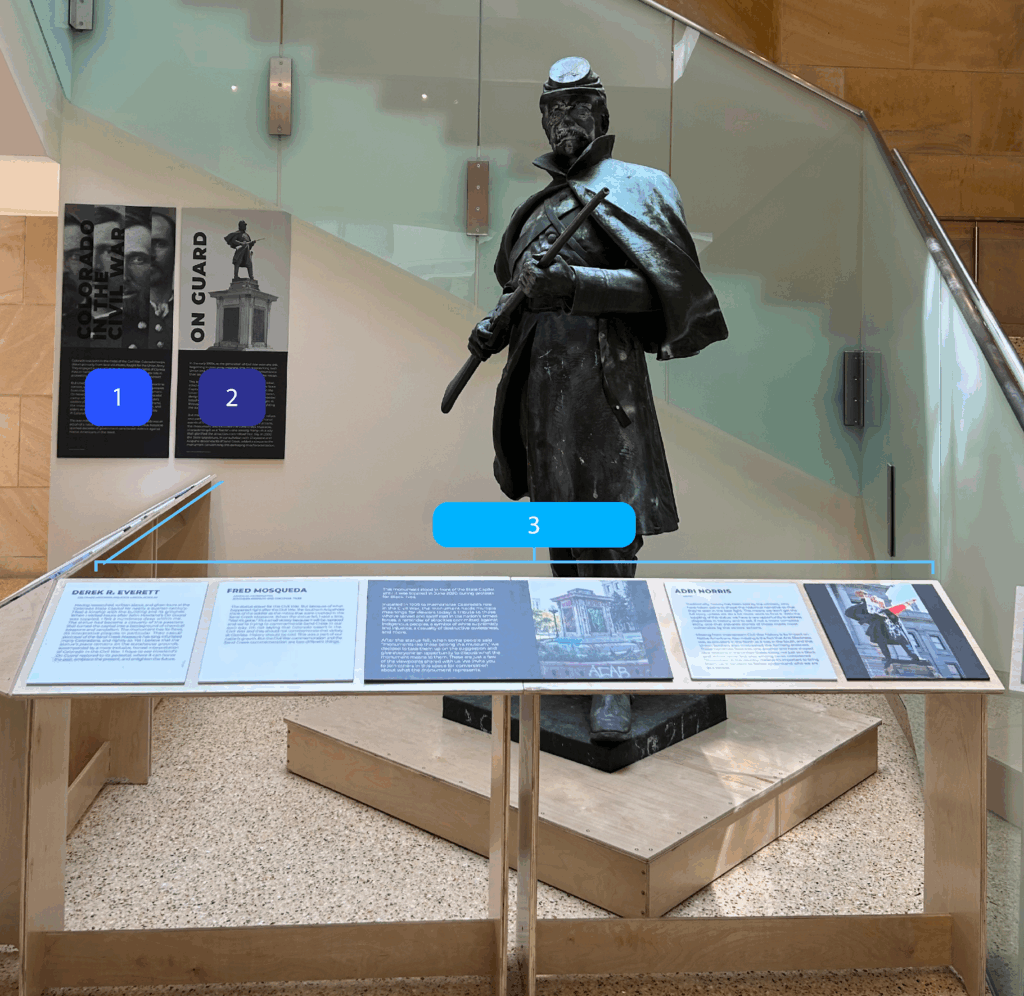
Relocation & Recontextualization/Reinterpretation Frameworks. Explore definitions here.
Acknowledgements
Thank you to Sydney Pursel, James Pepper Henry, Dave Loewenstein, and Jay T. Johnson whose editing and feedback helped improve this report.
Introduction
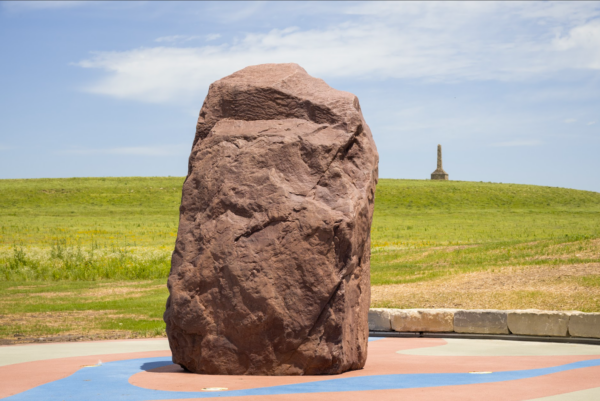
For thousands of years, Iⁿ‘zhúje‘waxóbe, the Sacred Red Rock, stood at the confluence of the Kaw (Kansas) River and Shunganunga Creek. Iⁿ‘zhúje‘waxóbe is a large, 28-ton red quartzite boulder of spiritual significance to the Kanza (also known as Kaánza, Konza, and Kaw). The land known today as the state of Kansas was named after the tribe and stewarded by the Kanza for several centuries before the arrival of white settlers. After a series of displacements by the U.S. government in the 1800s, the Kanza were forced to move to a reservation in Oklahoma. Today, the Kaw Nation is a federally recognized tribe headquartered in Kaw City, Oklahoma.
In 1929, descendants of settlers from Lawrence, Kansas, took Iⁿ‘zhúje‘waxóbe from the river and moved the stone to Lawrence’s Robinson Park. Iⁿ‘zhúje‘waxóbe was appropriated as a monument to Lawrence’s “founders,” and a plaque was affixed to the stone’s face. Iⁿ‘zhúje‘waxóbe stood in Robinson Park this way until 2023. Today, Iⁿ‘zhúje‘waxóbe lives at the 165-acre Allegawaho Memorial Heritage Park near Council Grove, KS, on land owned and stewarded by the Kaw Nation. The Founders Memorial plaque, once affixed to the stone, is on exhibit at the Watkins Museum of History in Lawrence. The effort to “rematriate” (Huffman and Edwards n.d.) Iⁿ‘zhúje‘waxóbe was led by the Kaw Nation with support from the Sacred Red Rock Project and others.
Robin R.R. Gray (2022) defines rematriation “as an embodied praxis of recovery and return” that “is about revitalizing the relationship between Indigenous lands, heritage, and bodies based on Indigenous values and ways of knowing, being, doing” (p.5). Rematriation is different from repatriation, a term that describes, among other actions, the return of cultural belongings and human remains from museums to their communities. Repatriation is a legal framework for regulating change of ownership. As C. Huffman and Tai S. Edwards (n.d.) state,
Rematriation is Indigenous.
Rematriation encompasses repatriation.
Rematriation centers Indigenous relationships to the Land.
Rematriation is comprehensive and unconditional.
Rematriation restores balance.
Rematriation is nothing new.
Rematriation shokhíbe*.
*is arriving back at one’s home
Section 1: Background
1.1. Iⁿ‘zhúje‘waxóbe, the Sacred Red Rock
During the Pre-Illinoian ice limit, which occurred approximately 1.8 million to 500,000 years ago, glaciers covered large portions of Canada and the upper Midwest. As the glaciers moved, they bulldozed everything in their path, picking up and moving them within the ice sheets. When the glaciers melted around 500,000 years ago, red quartzite boulders from present-day Minnesota and South Dakota were left along the glaciers’ paths southward, ending in northwestern Kansas, northern Missouri, and Illinois. These migrant stones stuck out in their new environments because red quartzite is not naturally found in places like Kansas, where limestone dominates the landscape. One of these red quartzite rocks was deposited at the confluence of the Kaw (Kansas) River and Shunganunga Creek near present-day Tecumseh, KS. Kanza people met and started a relationship with this particular stone in the 1400’s after separating from the larger Dhegiha Group (which also included the Omaha, Ponca, Osage, and Quapaw tribes) and settling in present-day Kansas. The boulder is known as Iⁿ‘zhúje‘waxóbe to the Kaw people, which translates to “Sacred Red Rock” in Kaánze íe, their language. For centuries, the Kanza have maintained a relationship with Iⁿ‘zhúje‘waxóbe.
According to Kaw citizen James Pepper Henry, Iⁿ‘zhúje‘waxóbe has and continues to hold significant spiritual meaning for the Kanza, as the stone embodies many of the qualities of the Creator: strength, resilience, and timelessness (personal interview 2025). Iⁿ‘zhúje‘waxóbe is a living spirit and a place where one can pay respect to the Creator. When Iⁿ‘zhúje‘waxóbe stood at the confluence of the Kaw (Kansas) River and Shunganunga Creek, it was near several Kaw villages along the river and served as a gathering place for the Tribe (ibid.).
Through force and coercion, the Kanza were removed from their historic homeland by the United States government. Kanza land was appropriated for eastern Indigenous American tribes actively being displaced and settlers who were encouraged to colonize westward by the U.S. government throughout the 1800s. In 1825, 1846, and 1859, treaties continually reduced the Kaw territory. According to the Kaw Nation (2022c), this “succession of treaties sought to change the Kaw from an independent, semi-sedentary people into individual family farmers on the model of white agricultural society. The results were devastating to the tribe.” A federal act in 1872 forced the Kanza to move from their reservation near Council Grove to Oklahoma’s Indian Territory. Prior to colonization, the Kaw population numbered several thousand. This was reduced to 1,500 by 1800 due to disease and starvation, to 553 by 1872, when they were removed from Kansas, and to 194 within 16 years of their move to Oklahoma (ibid.).
James Pepper Henry noted that because generations of Kaw children were forced to suppress their language and history in boarding schools, the memory of some places or things sacred and ceremonial to the Kanza was fading (personal interview 2025). The memory of Iⁿ‘zhúje‘waxóbe’s life is shared today thanks to those who carried the story, such as James Pepper Henry’s Uncle.
1.2. Appropriation of the Sacred Red Rock as the Lawrence Founders Memorial
In 1929, citizens of Lawrence, Kansas, commemorated the 75th anniversary of their town’s founding in 1854. To celebrate, they appropriated Iⁿ‘zhúje‘waxóbe as a monument to the city’s “founders” and moved the stone to Robinson Park. The park is named after Charles Robinson, who was a leader of the New England Emigrant Aid Company (NEEAC), the first governor of Kansas, and superintendent of the Haskell Institute from 1887-88. The Haskell Institute was located in Lawrence and “was created as part of the federal government’s policy to eliminate Indigenous people through cultural genocide” (Edwards n.d.). Today, the former Haskell Institute is Haskell Indian Nations University, a premier tribal college.
After moving the Sacred Red Rock to Robinson Park, Iⁿ‘zhúje‘waxóbe was defaced with a plaque. The plaque reads: “To the pioneers of Kansas who, in devotion to human freedom, came into a wilderness, suffered hardships and faced dangers and death to found this state in righteousness.” The individuals within the earliest parties of the New England Emigrant Aid Company to arrive at Lawrence are listed below. There is no mention of the Rock’s spiritual and cultural significance to the Kaw Nation, despite its well-documented status and its recognition by white settlers in the area, who also referred to the stone as the Kaw Prayer Rock.
The plaque’s statement of “devotion to human freedom” and founding Kansas “in righteousness” refers to the events surrounding the Kansas-Nebraska Act of 1854 and Kansas’ admission to the Union. The Kansas-Nebraska Act determined that Kansas and Nebraska would be established as states where enslaving people was either legal or illegal based on popular sovereignty. In response to this act, people sought to enter the Kansas and Nebraska territories and vote in favor of or against enslavement. The NEEAC was made up of “free-staters” who traveled to Kansas to live and vote in elections with the goal of making Kansas a state in which enslaving people was illegal. The organization established its headquarters in Lawrence in 1854.
However, the quest to “found [the] state in righteousness” was done so through the displacement of the Kanza and the erasure of their history with the land. According to James Pepper Henry, the stone’s dedication to the settlers’
quest for freedom… was really a slap in the face to our people. We had our freedom taken away so that white abolitionists who were against slavery could come to that area and establish themselves there by displacing us… They put the bronze plaque on [Iⁿ‘zhúje‘waxóbe] with wording that would be offensive to us. It is offensive to us today (personal interview 2025).
The acts of appropriating and defacing the Sacred Red Rock were insulting to the Kanza people, as were the words inscribed on the plaque affixed to its face. The Lawrence Founders Memorial stood in Robinson Park until 2023. Third graders in Lawrence would visit Robinson Park and the monument annually as part of their lessons on city history (Kekahbah et al. 2024).
Section 2: Iⁿ‘zhúje‘waxóbe’s Return to the Kaw Nation
2.1. The Movement for Rematriation
At several points since the 1990s, the Kaw Nation has approached the City of Lawrence to have the stone returned. Each inquiry was met with resistance.
Leaders within the Kaw Nation saw the national reckoning with monuments in 2020 as an opportunity to once again approach the City of Lawrence regarding the return of the Sacred Red Rock. As Vice Chairman of the Kaw Nation’s Tribal Council in 2020, James Pepper Henry pursued the return of the stone alongside Chairwoman Lynn Williams. The letter written to the Lawrence Mayor and sent to city and county commissioners stated:
On Sunday, October 11, 2020, the Kaw Nation held its quarterly General Council meeting. At that meeting, Kaw Nation citizens overwhelmingly voted in favor of having Iⁿ‘zhúje‘waxóbe or the “Big Red Rock” (as it is more commonly known) returned to the Kaw people. Please accept this letter as a formal claim of ownership of Iⁿ‘zhúje‘waxóbe, currently residing in Robinson Park in Lawrence, Kansas, and for its unconditional return to the Kaw Nation… Our intent for the return of Iⁿ‘zhúje‘waxóbe is to reclaim our role as its original stewards and to respectfully restore and renew its significance as a sacred item of prayer for our people… (Williams 2020).
On January 19, 2021, Lawrence City Commissioners voted unanimously to work with the Kaw Nation to return the Sacred Red Rock. They had received numerous messages of support for Iⁿ‘zhúje‘waxóbe’s return from community members. Joint City Resolution No. 7358 was then drafted and adopted on March 16, 2021. The resolution stated:
…The City and County recognize, honor, and commend the people of the Kaw Nation and other Native Peoples for their stewardship, cherishment, and protection of the lands of the City, County, and State for thousands of years before the arrival of European settlers. On behalf of all people of the City and County, the Governing Bodies of the City and Douglas County offer a sincere apology to all people of the Kaw Nation for the actions of community leaders in 1929 in appropriating Iⁿ‘zhúje‘waxóbe to honor White settlers on the occasion of the 75th Anniversary of the founding of the City. The City and County further express regret for the history of violence, maltreatment, neglect, and pernicious policies of the United States government and other units of government directed at the Kaw Nation and other Native Peoples through the history of this nation.
In a spirit of reconciliation and out of deep respect for the people of Kaw Nation, the City and County agree to work with the Kaw Nation and to cooperate fully in the return of Iⁿ‘zhúje‘waxóbe from the City to the Kaw Nation and to assist, as much as is necessary, in the relocation of Iⁿ‘zhúje‘waxóbe from the City to Allegawaho Heritage Memorial Park in Council Grove, Kansas.
The City and County further commit to working to forge a new relationship with the Kaw Nation and all Native Peoples built on respect and honor. Further, we, the City of Lawrence and Douglas County, Kansas, hope to earn the trust of the people of the Kaw Nation and all Native Peoples so that all people can co-exist peacefully and enjoy the freedom and equality that are the fundamental rights of all… (City of Lawrence, 2021b).
The response from the City of Lawrence and Douglas County to the Kaw Nation included a formal apology and serves as an example of action by local governing bodies conducted in the spirit of reconciliation.
On August 29, 2023, a ceremony was held in Robinson Park to mark and celebrate the return of Iⁿ‘zhúje‘waxóbe to the Kaw Nation. The event was a space for remembrance of what was taken from the Kaw people. James Pepper Henry (2023) remarked: “When our Kaw people gave an inch, the burgeoning Americans didn’t just take a mile, they took everything. Our lands, the bison that sustained us, our children, our language, our history, our culture, our sacred items.” The ceremony was also a space for community and celebration:
Just like Iⁿ‘zhúje‘waxóbe, the Kaánze people bear the scars of colonist expansion. These scars will always be reminders of our plight and our struggle to remain Kaánze. And just like Iⁿ‘zhúje‘waxóbe, our people are strong and resilient, and we continue to persevere through adversity. We can’t change the injustices of the past, but we can acknowledge that they occurred, and we can strive for reconciliation. The return of Iⁿ‘zhúje‘waxóbe is an historic moment for the Kaw people and the citizens of Kansas in this ongoing reconciliation effort (ibid.).
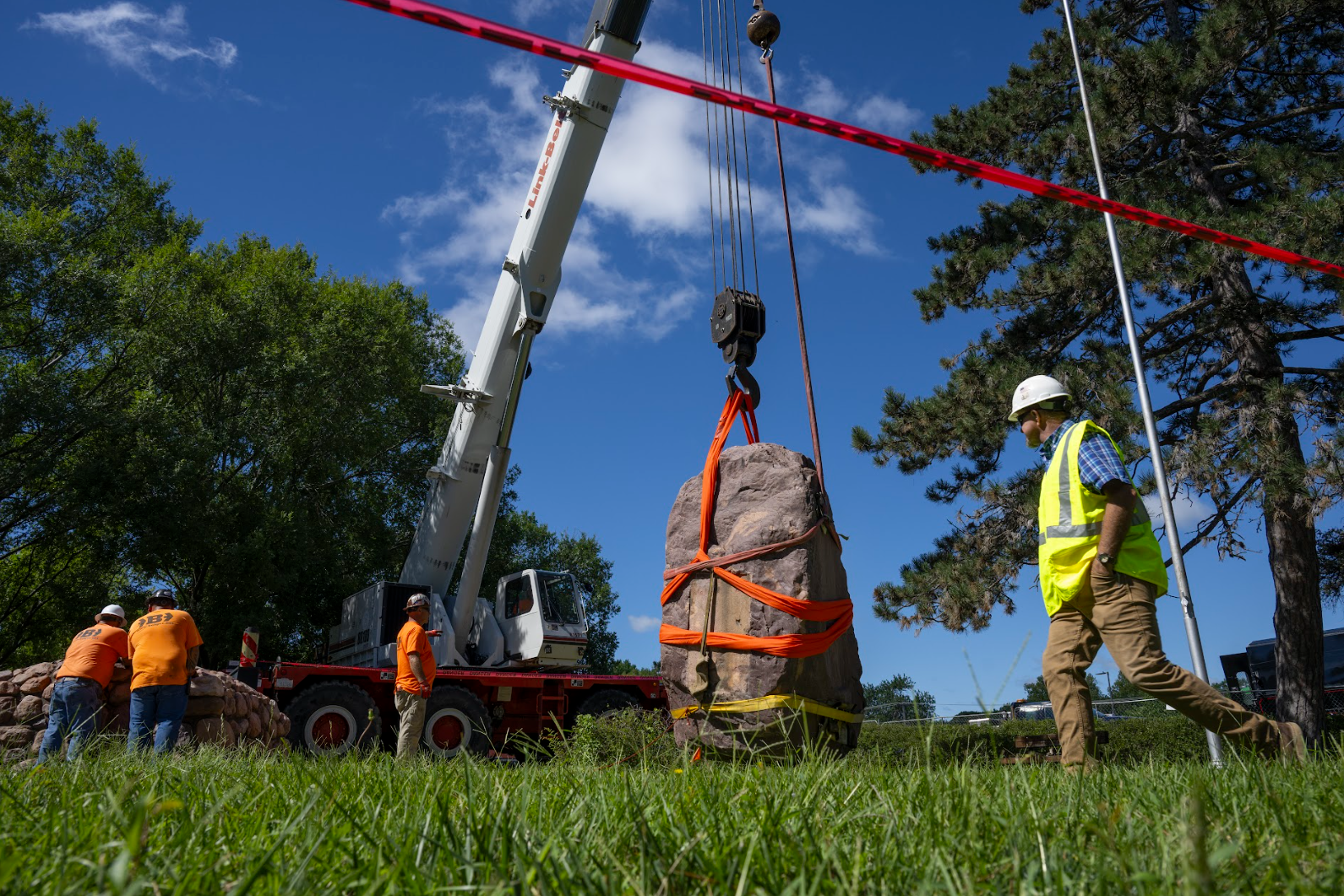
The plaque attached to the stone when Iⁿ‘zhúje‘waxóbe was defaced by Lawrencians was removed when the Sacred Red Rock was relocated from Robinson Park. The Kaw Nation agreed to loan the plaque to the Watkins Museum of History in Lawrence, where it is now on exhibit. James Pepper Henry explained:
We took the plaque off the stone and rather than destroying or disposing of the plaque, we loaned it to the local museum. We knew how important the plaque was for the history of the settlers. People tried to destroy our history and we didn’t want to be like those people. We didn’t want to destroy someone else’s history, even if it’s negative from our perspective (personal interview 2025).
2.2. Home at Allegawaho Memorial Heritage Park
The Sacred Red Rock remained in storage near Council Grove, Kansas, while its new home at Allegawaho Memorial Heritage Park was prepared. In March 2024, Iⁿ‘zhúje‘waxóbe was moved to the park for installation.
A Rematriation Celebration was held at the park on June 22, 2024. The celebration of Iⁿ‘zhúje‘waxóbe’s return to the Kaw Nation included remarks by James Pepper Henry (2024), who stated:
We have been estranged from our Grandfather for more than 150 years and today we are reunited in this special place. Both Iⁿ‘zhúje‘waxóbe and our Ka’anza people have been moved around a bit, and now that we are together again, we will have many stories to share and new memories to make.
Today, the Sacred Red Rock is supported in place by a colorful plaza that depicts Iⁿ‘zhúje‘waxóbe’s home before the stone’s removal at the confluence of the Kaw (Kansas) River and Shunganunga Creek. The scar left on the stone’s surface where the plaque once stood is visible as a reminder of the Sacred Red Rock’s history.
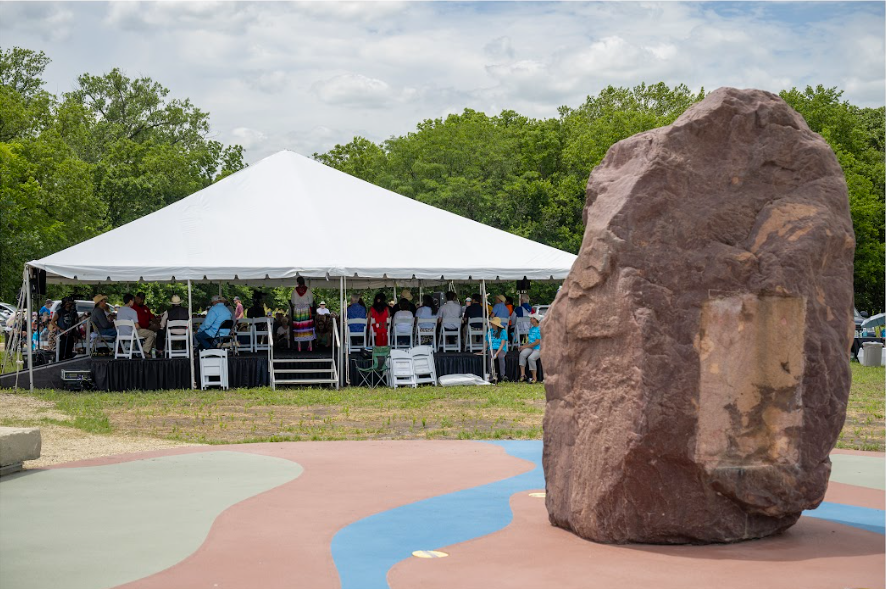
Allegawaho Memorial Heritage Park is located just outside of Council Grove, Kansas. It was established in 2002 on land that was part of the Kaw Nation’s last reservation lands in the state. The park’s purpose is to educate visitors about the Kaw Nation and its history, and thus, it is free and open to the public. Construction and improvements that added infrastructure and a new open-air welcome center to the park were completed in recent years. The story of Iⁿ‘zhúje‘waxóbe and the Kaw Nation is told through interpretive panels along a trail system throughout the park. Iⁿ‘zhúje‘waxóbe joins several monuments at the park, including the Monument to the Unknown Kaw Warrior and a dance arbor. In addition to the park improvements already completed, the Kaw Nation has plans to establish an RV-capable campground and implement a prairie restoration project.
Section 3: The Sacred Red Rock Project
3.1. The Project
The Sacred Red Rock Project team were strong supporters of the Kaw Nation’s effort to rematriate Iⁿ‘zhúje‘waxóbe. The project’s work began in 2015 as a small grassroots effort co-founded by colleagues and friends Pauline Eads Sharp and Dave Loewenstein. Dave Loewenstein had been leading a project that encouraged the expansion of state historical narratives through the creation of informational broadsides. When he sought to learn more about the Sacred Red Rock, Mr. Loewenstein reached out to Pauline Eads Sharp, whom he had previously been in contact with as a member of the Kaw Nation Cultural Committee. Ms. Sharp shared that her grandmother, Lucy Tayiah Eads, was the Chief of the Tribe when Iⁿ‘zhúje‘waxóbe was taken to Robinson Park. Describing the earliest stages of the project, Dave Loewenstein said: “Our intent was – because we didn’t have any resources, really – just to share this story with our communities, especially in Lawrence, with the city staff and elected leaders” (personal interview 2025).
The early project was called Between the Rock and a Hard Place. A small team was built with a 2019 grant from the Mid-America Arts Alliance. Community meetings organized by the project received a “remarkable” response and show of interest from people of the Kaw Nation and Lawrence (ibid.).
The growing public reassessment of monuments in 2020 was seen as a source of momentum for the project. In July of 2020, the project worked with the city to add banners at Robinson Park that highlighted its history. On October 11, 2020, Pauline Eads Sharp presented information to the Kaw Nation General Council about preliminary conversations with the city and county regarding the rematriation of the Sacred Red Rock. At this time, Kaw Nation citizens voted to request the return of the stone from the City of Lawrence and Douglas County. As mentioned, Vice Chairman of the Kaw Nation’s Tribal Council James Pepper Henry pursued the return of the stone alongside Chairwoman Lynn Williams.
In April of 2022, the Iⁿ‘zhúje‘waxóbe / Sacred Red Rock Project received a sizable grant from the Mellon Foundation. The grant included funding for the relocation of Iⁿ‘zhúje‘waxóbe, improvements at Allegawaho Memorial Heritage Park, a documentary film, a book, and an exhibition on the project. Project team members note that collaboration with the University of Kansas was key, as the University had the infrastructure and capacity to take on a grant of several million dollars (personal interviews 2025). Principal investigator Jay T. Johnson made clear in the grant application that the University’s role was to help facilitate, not lead, the effort. The wishes of the Kaw Nation would guide the work (personal interview 2025).
The Sacred Red Rock Project Leadership team is made up of representatives from several different entities, including the Kanza Heritage Society and Kaw Nation Tribal Council, the City of Lawrence, the Lawrence local artist community, the University of Kansas’ Institute for Policy & Social Research, and the Spencer Museum of Art. Namely, the team includes Pauline Eads Sharp, James Pepper Henry, Toni Wheeler, Dave Loewenstein, Jay T. Johnson, and Sydney Pursel. In addition, the Project expresses gratitude to many others who “shared their knowledge, skills, and experience,” including: Curtis Kekahbah, Curtis Charles Kekahbah, Lauren Kekahbah, Charlee Huffman, Tai Edwards, Sara Gregg, Beth Schultz, Dennis Domer, Brett Ramey, Dawn Buehler, Nicholas Ward, and David Roediger (SRRP n.d.a.).
3.2. Community Engagement Work
Throughout the Iⁿ‘zhúje‘waxóbe / Sacred Red Rock Project, the team worked closely with members of the Kaw Nation and the Lawrence community. In the early stages, this included collaborating to gather stories and research. As the project began and more formal community engagement sessions were held, the work took on many different forms.
The project received strong support and little to no opposition from community members. Team members visited schools and created curriculum to increase public awareness among the youth. Numerous public meetings were held in the local library and other spaces. Storytelling and artist workshops were also held to engage in conversation through different mediums. Ultimately, the rematriation of Iⁿ‘zhúje‘waxóbe was supported by a strong coalition of community members, several of whom wrote to city officials encouraging them to help facilitate the stone’s return.
3.3. The University of Kansas Spencer Museum of Art Exhibition -“Iⁿ‘zhúje‘waxóbe: Return of the Sacred Red Rock.”
The University of Kansas Spencer Museum of Art presented the exhibition Iⁿ‘zhúje‘waxóbe: Return of the Sacred Red Rock from September 9, 2025, to January 25, 2026. The exhibition was co-curated by the museum’s Curator for Public Practice, Sydney Pursel, and a multi-generational Advisory Council of Kaw Nation citizens. James Pepper Henry, Pauline Eads Sharp, Charlee Huffman, and Haskell student Kylie Mehojah served as advisors. The exhibition’s intent was to tell the story of the rematriation of Iⁿ‘zhúje‘waxóbe and featured art by community members, Lawrence local artists, Kaw Nation citizens, and Haskell Indian Nations University students. James Pepper Henry and Dave Loewenstein, among others, both contributed pieces to the exhibition. Each work is a reflection of the artist’s relationship with the stone (James Pepper Henry, personal interview 2025).
As a university museum, the Spencer Museum has a built-in audience of students. University classes, as well as students in the K-12 Lawrence school district, visit the museum annually. According to Sydney Pursel, every third and fourth-grade student in Lawrence visits the Spencer Museum (personal interview 2025). The Iⁿ‘zhúje‘waxóbe: Return of the Sacred Red Rock exhibit was an important supplement to the young students’ curriculum on Kansas state history.
Ultimately, the exhibit contributed to the goals of the Sacred Red Rock Project by existing as another platform to share the story of Iⁿ‘zhúje‘waxóbe and the history of the Kaw Nation (ibid.). It is also a celebration of all the work that went into the monumental accomplishment that was the return of Iⁿ‘zhúje‘waxóbe to the Kanza people (ibid.).
3.4. The Future of Robinson Park
Another element of the project was, and remains, the reimagining of Robinson Park. The community faces the question of what the space should look like now that Iⁿ‘zhúje‘waxóbe has been rematriated. Conversations about this topic are still ongoing. Today, two interpretive panels stand in the park to speak to the history of the land and Iⁿ‘zhúje‘waxóbe.
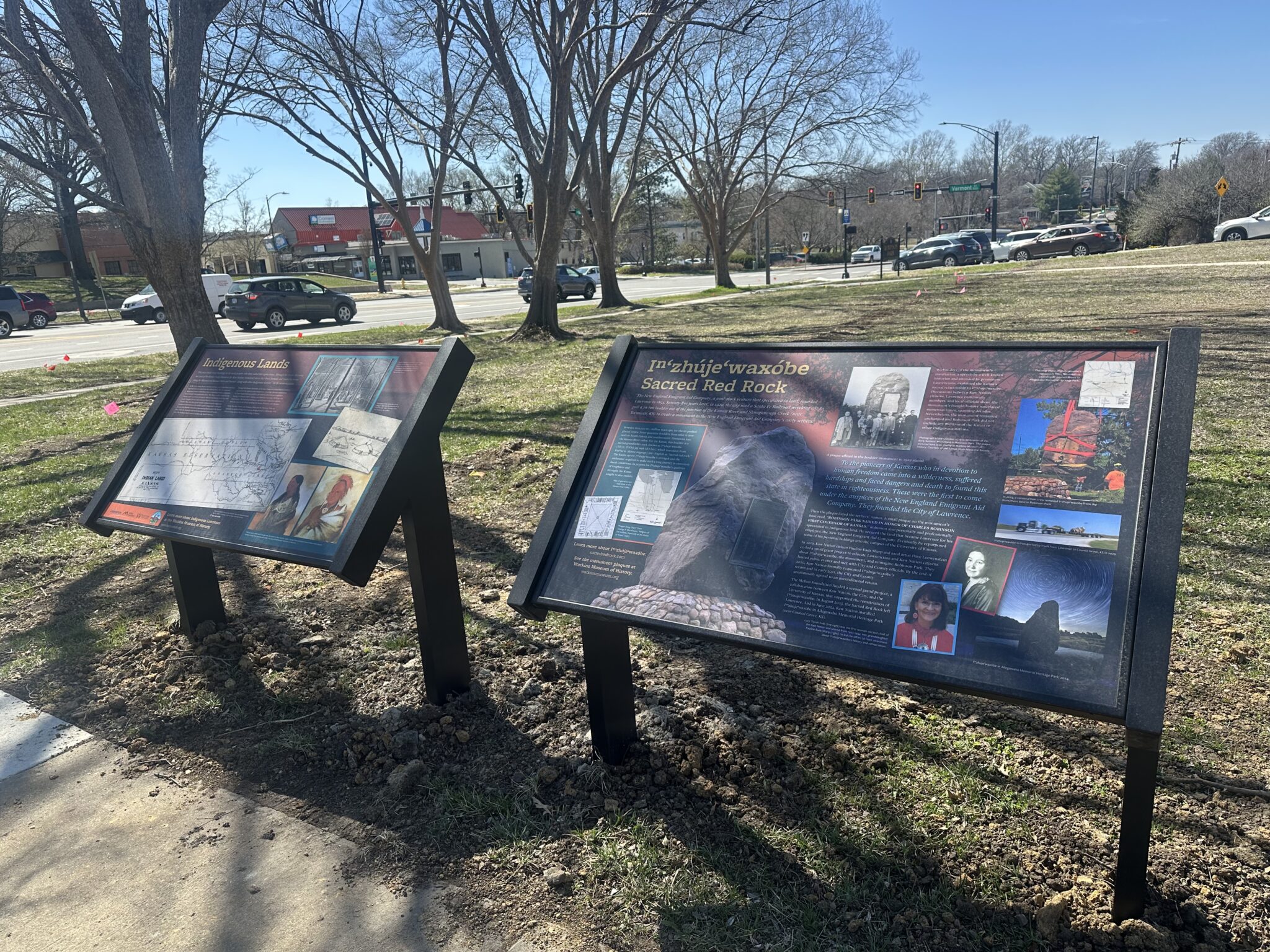
According to James Pepper Henry,
When the stone was removed it left a void in the park and it’s not our goal to erase ourselves from the memory and the history of the community. So, part of the Mellon funding was to come up with a plan to reenvision Robinson Park where the stone was for all those years – for almost 100 years – and to continue to have a presence even though most people didn’t know the stone was associated with the Kaw people. It’s an opportunity for us to have a presence, a notable presence, in Lawrence so people don’t forget whose land they’re on (personal interview 2025).
Section 4: Framework
In discussion of the Monuments Toolkit framework, the monument will be the Sacred Red Rock, Iⁿ‘zhúje‘waxóbe.
4.1. 1929: Appropriation, Relocation & Recontextualization/Reinterpretation
Iⁿ‘zhúje‘waxóbe was appropriated, relocated, and reinterpreted when the stone was moved to Robinson Park in 1929. The Sacred Red Rock’s reinterpretation, which was an “attempt to transform In‘zhúje‘waxóbe from a being (a relative to the Kanza) to a thing (a rock)[,] is emblematic of settler colonialism’s ongoing cultural genocide and appropriation of Indigeneity as a process of erasure” (Kekahbah et. al 2024, p.116). Monuments to settlers, pioneers, and founders are commonplace in the American West. They began to appear in the early twentieth century, “usually dedicated by the children or grandchildren of settlers in an attempt to legitimate their claims to the land by memorializing their western heritage and identity” (ibid., p. 121). Identifying “founders” of a place implies that the people arrived to a land that had not already been known, cultivated, and stewarded for hundreds or thousands of years. Such narratives work to erase the history of Indigenous Americans across the United States, and particularly in the American West. The New England Emigrant Aid Company, claiming that their party had founded Lawrence in “righteous freedom,” dismissed the fact that the land they were on had been the homeland of the Kanza for several centuries before their arrival. Iⁿ‘zhúje‘waxóbe’s appropriation erased the story of the Kanza people (James Pepper Henry, personal interview 2025).
4.2. 2023/2024: Rematriation, Relocation & Recontextualization/Reinterpretation
For many years, grassroots efforts, community engagement, and public outreach had been undertaken to raise awareness of the history of Iⁿ‘zhúje‘waxóbe while the stone stood in Robinson Park. This work ultimately led to the return of Iⁿ‘zhúje‘waxóbe to the Kaw Nation in 2023. The rock was relocated to Council Grove, Kansas, and stored before being installed at Allegewaho Memorial Heritage Park in 2024.
In Allegawaho Memorial Heritage Park, Iⁿ‘zhúje‘waxóbe is honored as a sacred ancestor. Describing Iⁿ‘zhúje‘waxóbe in the park, James Pepper Henry said:
It’s the land that we belong to, and we brought the stone to land that it belongs to… We couldn’t put it back in its original location because it was on private land and access was a challenge and all these other things. But where it is at now, it has protection. It has our protection. It’s in our stewardship, so it’s better protected. We can keep an eye on it (personal interview, 2025).
4.3. Monument of Reconciliation
Today, Iⁿ‘zhúje‘waxóbe resides on land, in Kansas, stewarded by the Kaw Nation. The stone stands on a concrete platform that depicts Iⁿ‘zhúje‘waxóbe’s location at the confluence of the Kaw (Kansas) River and Shunganunga Creek, where Kaw people first met and started a relationship with the massive boulder.
The Monuments Toolkit framework defines a Monument of Reconciliation as “a monument that reconciles with historical traumas.” The process of reconciliation and healing is extensive and cannot be accomplished with a few actions. However, the response from the City of Lawrence and Douglas County was a step in the right direction. Including a formal apology and a statement of commitment to build a relationship with the Kaw Nation and all Native peoples, grounded in trust, honor, and respect, was meaningful. Iⁿ‘zhúje‘waxóbe’s rematriation is one piece of the reconciliation process between the Kaw Nation and those who led, facilitated, and/or were complicit in the attempt to erase Kanza history.
References
City of Lawrence. 2021a. “Agenda Item Report. City Commission.” January 19, 2021. https://lawrenceks.civicweb.net/document/58528/Discussion%20of%20the%20letter%20received%20by%20Lynn%20Willi.pdf?handle=44CF65DB92494D30B00327F10A5F09A4
— 2021b. “Agenda Item Report. City Commission.” March 16, 2021. https://lawrenceks.civicweb.net/document/62301/Consider%20adopting%20Joint%20City%20Resolution%20No.%20735.pdf?handle=3661DCB32DD74837A81081F0D7B5F48C
Edwards, Tai. N.d. “Sacred Red Rock Project: About Charles Robinson.” Accessed December 17, 2025. https://sacredredrock.com/about-charles-robinson/.
Etcheson, Nicole. N.d. “Bleeding Kansas: From the Kansas-Nebraska Act to Harpers Ferry.” Kansas City Public Library. Accessed January 3, 2026. https://civilwaronthewesternborder.org/articles/bleeding-kansas-kansas-nebraska-act-harpers-ferry
Garrison, Zachary Stewart. N.d. “Kansas-Nebraska Act.” Accessed January 3, 2026. https://civilwaronthewesternborder.org/encyclopedia/kansas-nebraska-act.
Gray, Robin R.R. 2022.“Rematriation: Ts’msyen Law, Rights of Relationality, and Protocols of Return.” Native American and Indigenous Studies 9 (1): 1-27. https://doi.org/10.1353/nai.2022.0010
Huffman, C. and Tai S. Edwards. N.d. “Rematriation of Iⁿ‘zhúje‘waxóbe.” Accessed December 5, 2025. https://sacredredrock.com/rematriation-of-i%e2%81%bf-zhuje-waxobe/.
Pepper Henry, James. 2023. Iⁿ‘zhúje‘waxóbe removal ceremony remarks. August 29, 2023.
—2024. Rematriation ceremony remarks. June 22, 2024.
Kaw Nation. 2022a. “Historical Events.” September 15, 2022. https://www.kawnation.gov/historical-events/.
— 2022b. “The History of Kaw Nation.” September 15, 2022. https://www.kawnation.gov/history-of-kaw-nation/.
— 2022c. “The Kanza People.” September 15, 2022. https://www.kawnation.gov/the-kanza-people/.
— n.d. “Kaw Nation: People of The Southwind.” Accessed January 15, 2026. https://www.kawnation.gov/.
Kekahbah, Curtis, Hayden L. Nelson, C. Huffman, and Tai S. Edwards. 2024. “Ín, Monyón, Shokhí (Rock, Theft, Returning Home): Rematriating In‘zhúje‘waxóbe.” Kansas History: A Journal of the Central Plains 47, no.2 (Summer 2024): 110-125.
National Native American Boarding School Healing Coalition. N.d. “US Indian Boarding School History.” Accessed December 10, 2025. https://boardingschoolhealing.org/us-indian-boarding-school-history/.
Prichard, Jeremy. N.d. “New England Emigrant Aid Company.” Kansas City Public Library. Accessed January 3, 2026. https://civilwaronthewesternborder.org/encyclopedia/new-england-emigrant-aid-company.
Sacred Red Rock Project (SRRP). N.d.a. “About us.” Accessed December 1, 2025. https://sacredredrock.com/about-us/.
— N.d.b. “Background of Iⁿ‘zhúje‘waxóbe.” Accessed December 5, 2025. https://sacredredrock.com/background-of-inzhujewaxobe/.
— 2025. “Storymap of Iⁿ‘zhúje‘waxóbe.” June 17, 2025. https://sacredredrock.com/storymap-of-inzhujewaxobe/.
Stanley, Matthew. N.d. “First Sack of Lawrence.” Kansas City Public Library. Accessed January 3, 2026. https://civilwaronthewesternborder.org/encyclopedia/first-sack-lawrence.
Williams, Lynn. 2020. Letter to Honorable Jennifer Ananda, Mayor. November 30, 2020. https://sacredredrock.com/wp-content/uploads/2022/12/rematriation_resolution_20201130_kaw_nation_request_to_city_of_lawrence.pdf