Co-location Framework. Explore definitions here.
Introduction
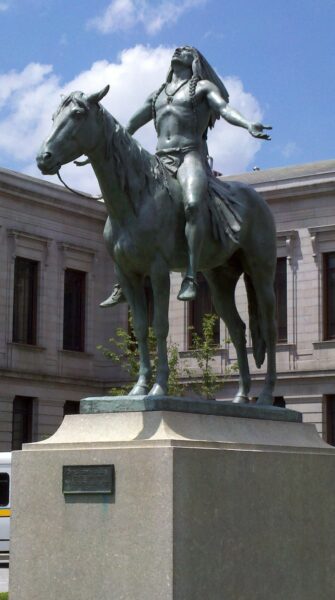
Prominently displayed at the entrance to the Museum of Fine Arts Boston, Appeal to the Great Spirit was sculpted by American artist Cyrus Dallin in 1908. It was greatly admired at the time of its creation and for many decades thereafter. However, the work has been viewed more critically in recent years and its significance has been tempered by co-location with other displays. This case study briefly examines the history of artistic depictions of Native Americans and describes current approaches to interpreting Dallin’s sculpture more fully. The “Garden for Boston” project and The Knowledge Keepers installation provide examples of Indigenous American artists reinterpreting Appeal to the Great Spirit through co-location.
Section 1: Background
Scenes of the lives of Indigenous Americans have rarely been captured in monuments in the United States. This is not surprising given that monument designers of the past have tended to be white men with perspectives vastly different from those of their subjects. Even artists who claimed to respect and draw inspiration from Native American life and imagery may have unintentionally muddled the significance of symbols, customs, and clothing. In popular media, there are few examples of Indigenous characters that truly represent Native people and culture.
The legacy of artist Cyrus Dallin is a profound example of the paradox of good intentions. Born in Springville, present-day Utah, in 1861, Dallin had many encounters with the Ute population as he grew up. Over time he became dismayed at the systemic oppression of the Ute and other Indigenous communities. Heather Leavell, director and curator at the Cyrus Dallin Art Museum, writes, “Dallin witnessed the Ute’s way of life change from that of a relatively free people to one of forced confinement, starvation and disease on the barren Uintah reservation. He was deeply disturbed by these and other crimes perpetrated against Native peoples” (Leavell, 2018).
Dallin was an outspoken advocate of fairer treatment of Indigenous Peoples. Leavell points out that Dallin defended the property and human rights of Native tribes during his time as the chair of the Massachusetts Branch of the Eastern Association of Indian Affairs. He also played a large role in thwarting the Bursum Bill in 1922, which would have enabled non-Native stakeholders to claim Pueblo land if they could prove that they had maintained a 10-year residency (Leavell, 2018). Emily Burns, assistant professor of art history at Auburn University, writes, “In innumerable instances, it has seemed that the Indians had no rights which the white man were bound to respect” (Burns, 2018).
Section 2: The Site’s Controversy
Despite his activism and staunch defense of Indigenous Americans, Dallin’s artistic representations of Native Americans are inaccurate and perpetuate racist mythology. His fourth monument depicting an Indigenous person, Appeal to the Great Spirit, was installed outside the Huntington Avenue entrance to the Museum of Fine Arts Boston (MFA Boston) in 1912. The equestrian monument features an Indigenous warrior. He wears a war bonnet, carries no weapons, and the variety of iconography adorning his body makes him impossible to identify with a specific Indigenous group (Phelps, 2024). His arms are outstretched as he looks to the sky. The Huntington Avenue entrance is the entrance point used by the great majority of visitors to the museum, including those arriving by tram and car service.
On Indigenous Peoples Day in 2019, curators at the MFA Boston launched a project that invited Indigenous Peoples to comment on how they perceive Cyrus Dallin’s work. Their feedback was displayed on white picket signs strategically placed around the monument space. The installation was later preserved on the museum’s website along with the visitors’ handwritten notes.
Comments indicated a disapproval of Dallin’s jumbling of Native American iconography and a preference for more accurate depiction of a particular tribe or tribes. Some Indigenous visitors felt that the man’s pose on the horse was a powerful symbol of defiance. Others saw the pose as supplicating—an idea that would play into the “vanishing race” myth. One visitor remarked, “It tells me that the museum is not for native people like me, but for white people and their false impressions of reality” (MFA Boston, 2019b). Another visitor wrote in praise of Dallin’s artistry: “Since childhood I have always loved this statue as it always stood as a symbol of pride … Asnutaneyan! We are still here! – Wunnamwau Thomas Frederick” (MFA Boston, 2019a). The diversity of feedback from the event hints at the difficulty of reimagining Appeal to the Great Spirit for contemporary visitors.
Section 3: Framework – Co-location
The MFA Boston chose the strategy of co-location to temper the meaning of Dallin’s Appeal to the Great Spirit. The Monuments Toolkit team defines co-location as “the act of adding additional monuments to temper the meaning and significance of the original monument.”
2021
In 2021, the MFA Boston launched a project titled “Garden for Boston” in the space around Appeal to the Great Spirit. Boston local Euka Holmes and Elizabeth James-Perry of the Aquinnah Wampanoag tribe each installed their own project on site: Holmes planted 3,000 sunflowers for “Radiant Community,” a project that uses sunflowers to spread beauty and hope throughout the historically Black Boston neighborhood. James-Perry planted a field of corn, beans, and sedges in the shape of a horseshoe crab framed by crusted shells in her installation titled “Raven Reshapes Boston: A Native Corn Garden at the MFA” (MFA Boston, 2021). Flowers and crops are items of intrinsic cultural value as well as symbols of rebirth. Alongside Dallin’s statue, they serve to shift visitors’ focus away from the iconography of the monument and toward the space it occupies. This in turn leads to new reflections on the notion of the “disappearance” of Native Americans. In the words of Melissa Ferretti of the Herring Pond Wampanoag tribe, “The truth is that people just don’t realize that there are Indigenous people living in their own community … we’re actual descendants of the original peoples that were here” (Gordon, 2021).
2024
The MFA Boston launched the Huntington Avenue Entrance Commission initiative in 2024 as part of the broader effort to reimagine the museum’s campus as seen through the “Garden for Boston” project. The Huntington Avenue entrance is a prime space for dialogue between artworks as this is where the Appeal to the Great Spirit sculpture continues to stand. Indigenous American artist and curator Alan Michelson was commissioned to create the initiative’s first installation: The Knowledge Keepers.
Michelson’s installation includes two sculptures depicting contemporary individuals from local tribes: Aquinnah Wampanoag member Julia Marden and Nipmuc artist Andre StrongBearHeart Gaines Jr. (MFA Boston, n.d.). Both stand in “dynamic gestures of public address” atop plinths on either side of the Huntington Avenue entrance doors (ibid.). Of the works, Michelson stated: “In 2024, I hope my site-specific installation will challenge ingrained stereotypes and racial myths by presenting a story of survivance and agency, not defeat or appeal” (Phelps, 2024). The bronze sculptures with platinum gilt are another example of the power of co-location. The juxtaposition of Michelson’s sculptures of specific contemporary Indigenous knowledge keepers with Cyrus Dallin’s stereotypical and inaccurate depiction of a general Indigenous American person challenges visitors to think critically about the implications of monuments such as Dallin’s.
References
Association on American Indian Affairs. (2023). Honoring a Century of Service. Association on American Indian Affairs. Retrieved from https://www.indian-affairs.org/100years.html#:~:text=The%20bill%20threatened%20an%20estimated,Lands%20Act%20of%201924%E2%80%8B
Burmeo, L. (2023). A Closer Look at Appeal to the Great Spirit [Video]. MFA Boston. Retrieved from https://www.mfa.org/collections/art-americas/appeal-to-the-great-spirit/a-closer-look
Burns, E. C. (2018). Political Contestation in Cyrus Dallin’s American Indian Monuments [PDF]. Archives of American Art Journal 57(1), 4-21.
Gordon, P. (2021, August 7). Rethinking Appeal to the Great Spirit. Survive and Thrive Boston. Retrieved from https://surviveandthriveboston.com/index.php/rethinking-appeal-to-the-great-spirit/
Leavell, H. (2018, July/August). New Research Sheds Light on Cyrus Dallin’s Activism for Native Rights in The Schout. Cyrus Dallin Art Museum Newsletter. Cyrus Dallin Art Museum. PDF. Acquired by the Boston Museum of Fine Arts.
MFA Boston (2019a). Cyrus Dallin’s Appeal to the Great Spirit. Museum of Fine Arts Boston. Retrieved from https://www.mfa.org/collections/art-americas/appeal-to-the-great-spirit
MFA Boston (2019b). Visitor Responses to “Appeal to the Great Spirit.” Museum of Fine Arts Boston. Retrieved from https://www.mfa.org/collections/art-americas/appeal-to-the-great-spirit/visitor-responses
MFA Boston (2021, August 10). Before Boston: Black and Native Histories of Place [Video]. YouTube. https://www.youtube.com/watch?v=iYmFxw7nTok
MFA Boston (n.d.). Huntington Avenue Entrance Commission: The Knowledge Keepers. MFA Boston News. Retrieved April 6, 2026, from https://www.mfa.org/exhibition/huntington-avenue-entrance-commission-the-knowledge-keepers.
Phelps, R. (2024, November 14). An Indigenous Artist’s Response to an Iconic, Divisive Statue. TuftsNow. Retrieved from https://now.tufts.edu/2024/11/14/indigenous-artists-response-iconic-divisive-statue.
Soliz, S. (2019, August 22). Pueblo Activists and Allies against the Bursum Bill of 1921. Sarweb. Blog. Retrieved from https://sarweb.org/pueblo-activists-and-allies-against-the-bursum-bill-of-1921/
The Diplomatic Reception Rooms. (2023). Appeal to the Great Spirit [Native American Bronze Equestrian Statue]. U.S. Department of State. Retrieved from https://www.diplomaticrooms.state.gov/objects/appeal-to-the-great-spirit-native-american-bronze-equestrian-statue/
Tyquiengco, M. (2021, September 29). Garden for Boston. MFA Boston. Retrieved from https://www.mfa.org/article/2021/garden-for-boston
Whyte, M. (2021, May 11). New thinking crops up (literally) around MFA’s “Appeal to the Great Spirit.” Boston Globe. Retrieved from https://www.bostonglobe.com/2021/05/11/arts/new-thinking-crops-up-literally-around-mfas-appeal-great-spirit/
Zordan, S. (2020, July 6). Appeal to the Great Spirit. Museum of Fine Arts Boston. Retrieved from https://www.mfa.org/article/2020/appeal-to-the-great-spirit.